[research] · · 4 min read
Anthropic data centers to emit 32 million tons CO2 by 2028
A new analysis reveals that despite public pledges, Anthropic's US compute expansion relies almost entirely on gas turbines and coal, with no direct renewable commitments in the US.
By ByteBulletin Editor · Editor
AI-generated illustration · Z-Image-Turbo, self-hosted
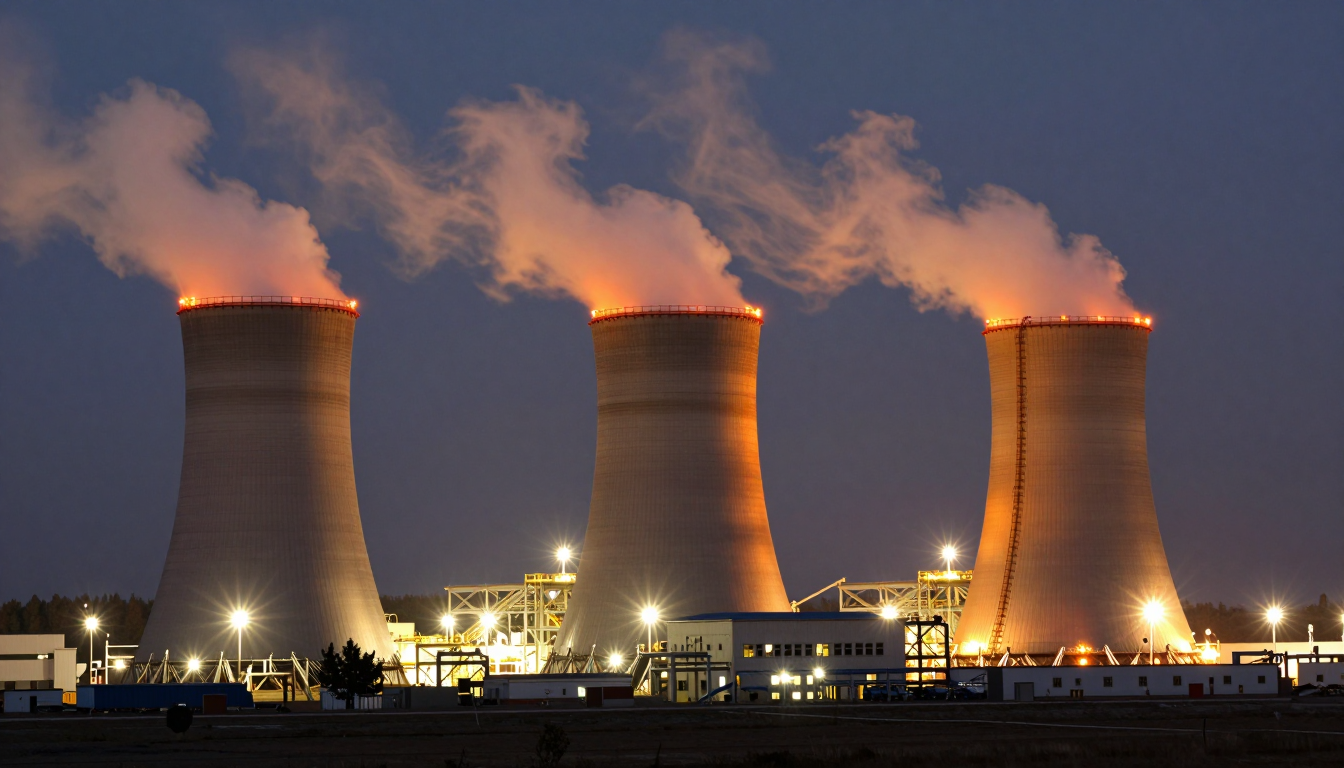
The Better Data Center Project reports that Anthropic's expanding US data center footprint is overwhelmingly powered by fossil fuels, with no direct commitments to renewable energy in the United States. According to the analysis, published in November 2026, the company has contracted 15 GW of compute capacity, with an estimated 87% of its power coming from gas and 11% from coal by 2028. This reliance on non-renewable sources stands in contrast to Anthropic's public statements about broadening its energy mix with geothermal, wind, and solar, which the report notes are currently limited to Norway and Canada.
The scale of fossil fuel dependency
The report details that Anthropic recently purchased commitments for 1.7 gigawatts of heavy-duty gas generators for $3.4 billion. This on-site generation strategy, known as "Bring Your Own Power" (BYOP), is part of a broader trend where 177 GW of planned BYOP gas capacity is being secured across the US. The analysis estimates that Anthropic's total CO2 emissions from power use at these sites could reach 17–38 million metric tons of CO2 equivalent per year in 2028, with a mid-case estimate of 32 million metric tons. To contextualize this volume, the report notes that 9.6 GW of Anthropic's contracted capacity could power approximately 7 million homes or cover 18% of California's peak power demand.
Inefficient turbines and health impacts
A significant portion of Anthropic's on-site power infrastructure relies on inefficient technology. The report finds that 80% of the company's on-site power capacity consists of simple cycle turbines and engines, which are less efficient and more polluting than modern combined cycle plants. Specifically, 25% of Anthropic's contracted power, or 2.5 GW, comes from these behind-the-meter gas sources. The environmental impact extends beyond carbon emissions; the analysis estimates that air pollution from these sources could cause $2–3 billion in annual health damages, driven by over 13,000 tons per year of nitrogen oxides and 2,000 tons per year of fine particulate matter.
Specific site controversies
The report highlights specific facilities where regulatory and environmental concerns are acute. Anthropic has used compute capacity at SpaceX’s Colossus 2 facility since May 2026, which relies on temporary, unpermitted turbines that largely lack selective catalytic reduction (SCR) technology. By the end of 2026, Anthropic is expected to draw as much as 600 MW from this site. Additionally, the company has contracted 460 MW of power from Nscale’s Monarch Compute Campus in Mason, West Virginia, which utilizes reciprocating engines known for significant formaldehyde and hazardous air pollutant emissions. Anthropic has stated it requires emissions control technology from its power partners, yet the reliance on these specific, less-regulated sources creates a gap between policy and practice.
Methodology and data sources
The analysis by The Better Data Center Project relies on data from Epoch AI’s tracker, Anthropic’s filings, and partner announcements from Amazon and SpaceX. To model the power mix, the researchers used the EPA’s AVERT tool to determine which marginal generators would meet the incremental load from Anthropic’s facilities. The study assumes a Power Usage Effectiveness (PUE) range of 1.1–1.2 and power utilization rates of 60–80%, consistent with typical hyperscale data center operations. The findings are based on the 9.6 GW of capacity contracted to specific sites as of October 2026, with the understanding that total contracted compute stands at 15 GW.
What this means for the industry
This report underscores a critical disconnect between the sustainability goals of major AI labs and the physical reality of their infrastructure buildout. While Anthropic and other competitors have pledged to use renewable energy, the immediate demand for compute is being met by the fastest available power sources: gas and coal. For developers and enterprises relying on these models, the environmental cost of inference and training is increasingly tied to the geographic location of data centers and the local grid's carbon intensity. The report suggests that without explicit commitments to new renewable capacity, new AI load will continue to displace cleaner grid resources with dispatchable fossil fuels, exacerbating local air quality issues and carbon emissions.
What to watch
- Renewable Commitments: Whether Anthropic announces direct US renewable energy purchases or long-term power purchase agreements (PPAs) to offset its fossil fuel usage.
- Regulatory Scrutiny: Potential local or federal regulatory actions regarding the unpermitted turbines at Colossus 2 and the emissions from the Monarch Compute Campus.
- Grid Integration: How the US grid manages the integration of 177 GW of new BYOP gas capacity and its impact on overall grid stability and carbon intensity.
- Competitor Moves: Similar analyses of other major AI labs like OpenAI and Google to determine if Anthropic’s fossil-heavy strategy is an industry-wide trend or an outlier.
Get the signal, not the noise.
One short email when it matters. No recaps of recaps.
SOURCES
SHARE
RELATED

[research] ·
Anthropic mathematician claims Riemann hypothesis proof with Claude

[research] ·
Anthropic S-1 filing warns of imminent recursive self-improvement

[funding] ·
Anthropic IPOs on Nasdaq at $111.50 per share

[launches] ·
Nvidia board rejects Jensen Huang return as CEO

[funding] ·
OpenAI quarterly revenue crosses $10 billion
[launches] ·