[research] · · 3 min read
Anthropic mathematician claims Riemann hypothesis proof with Claude
Levent Alpöge says he solved one of the Millennium Prize problems using Claude, joining a wave of AI-driven breakthroughs in pure mathematics that is upending traditional verification processes.
By ByteBulletin Editor · Editor
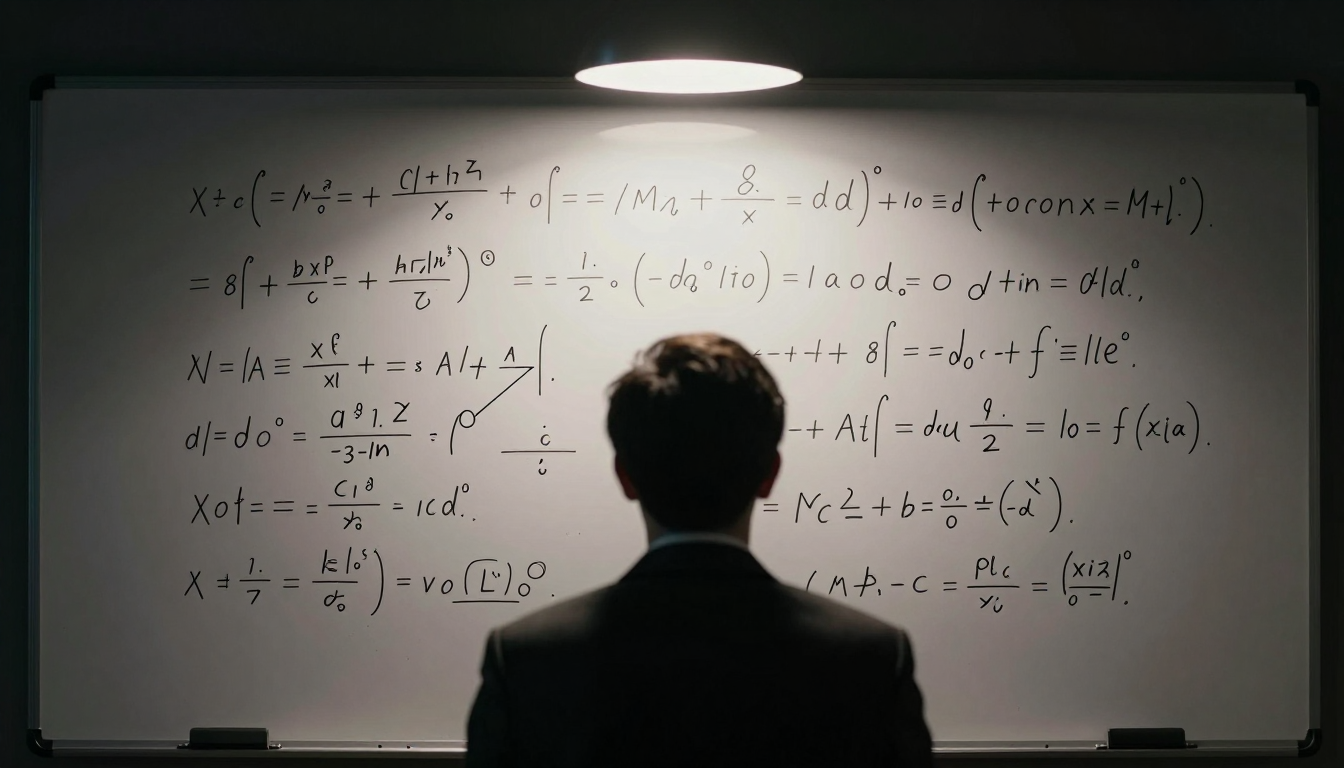
AI-generated illustration · Z-Image-Turbo, self-hosted
The Claim
Anthropic mathematician Levent Alpöge has announced that he has proved the Riemann hypothesis, one of the seven Millennium Prize problems, with the assistance of Anthropic’s Claude model. According to The Verge, Alpöge states on his personal website that he believes he has discovered a proof and that the method extends to the Generalized Riemann Hypothesis. Alpöge notes that he texted Anthropic CEO Dario Amodei about the solution late Sunday night and suggests he held off on publication until after the company’s IPO on Thursday. The proof has been presented in Lean, a formal proof assistant, and is currently available only on Alpöge’s website.
Verification and Status
The solution has not yet been independently verified or accepted by the Clay Mathematics Institute, which administers the Millennium Prize. Under the institute’s rules, a proposed solution must be published and withstand at least two years of scrutiny before it can be considered for the $1 million bounty. During this period, the proof must receive general acceptance in the global mathematics community. Anthropic has not commented on the announcement or involved itself in the verification process, despite reporting that it was working on the problem with Claude in August. At that time, Anthropic stated, “We don’t expect that the techniques Claude used will lead to proving the Riemann hypothesis.”
Context: AI in Mathematics
This claim follows a series of high-profile AI-driven mathematical breakthroughs. In September, OpenAI claimed to have cracked the Navier-Stokes problem, another Millennium Prize problem concerning fluid flow. OpenAI reported spending millions of dollars and deploying 10,000 agents in the attempt. The result is widely considered credible but has yet to receive formal recognition. The achievement has been marred by allegations of questionable research practices, including claims that OpenAI used unpublished work from mathematicians who had shared their research with its AI tools. OpenAI has strongly denied wrongdoing.
Alpöge also claimed in July that he solved the Jacobian conjecture using Claude. The deluge of findings has left mathematicians scrambling to digest the material and figure out where these results belong in what is rapidly becoming a profoundly different mathematical landscape. The Riemann hypothesis, first proposed in 1859, concerns the distribution of prime numbers and has eluded some of the world’s best mathematicians for decades. In the quarter-century since the Millennium Prize was established, only one problem has been officially solved: the Poincaré conjecture.
What It Means for Developers
For developers and technical readers, this development underscores the growing capability of large language models to assist in complex logical reasoning and formal verification. The use of Lean, a proof assistant, suggests that AI is not merely generating heuristic guesses but is capable of producing structured, verifiable arguments. This shift has implications for software engineering, where formal methods are increasingly used to ensure correctness in critical systems. Developers should watch for tools that integrate LLMs with proof assistants, as this combination may become a standard part of the workflow for high-stakes software development.
What to Watch
- Independent Verification: Whether the mathematical community accepts Alpöge’s proof after the two-year scrutiny period.
- Anthropic’s Response: Whether Anthropic officially endorses or distances itself from the claim.
- OpenAI’s Navier-Stokes Solution: Whether OpenAI’s solution receives formal recognition and how the controversy over research practices resolves.
- New Tools: The emergence of developer tools that combine LLMs with formal proof assistants like Lean.
Get the signal, not the noise.
One short email when it matters. No recaps of recaps.
SHARE
RELATED

[research] ·
Anthropic S-1 filing warns of imminent recursive self-improvement

[research] ·
Anthropic cuts internet access for all internal AI evaluations

[funding] ·
Anthropic IPOs on Nasdaq at $111.50 per share

[funding] ·
OpenAI quarterly revenue crosses $10 billion

[funding] ·
Anthropic sets IPO valuation range this week
[models] ·