[tooling] · · 2 min read
Vercel CEO Guillermo Rauch: The real battle is splitting the model from the agent
As AI agents move from prototypes to production, Vercel’s CEO argues that decoupling models from agent logic is the defining platform war of the next decade.
By ByteBulletin Editor · Editor
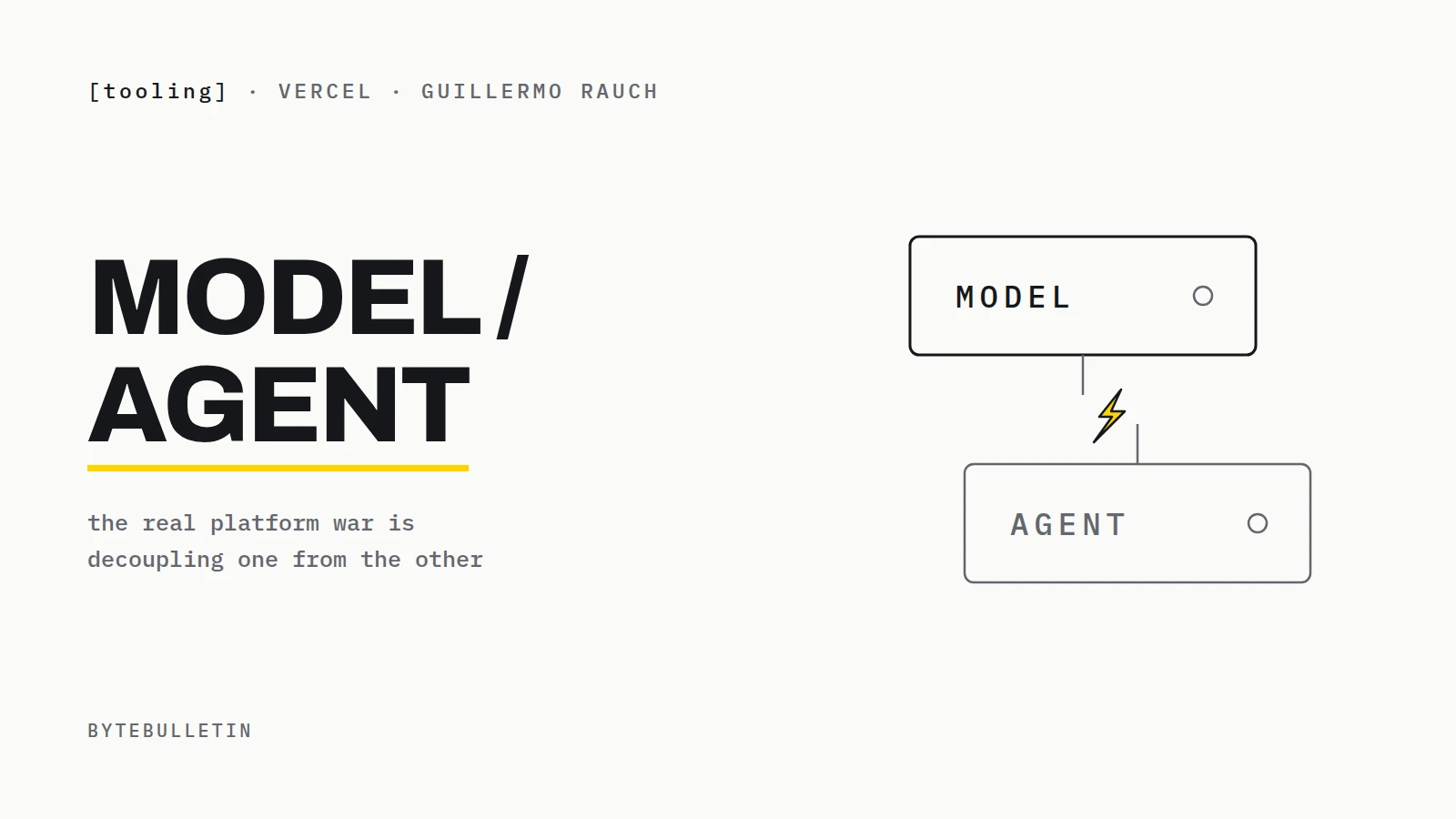
In a wide-ranging interview following Vercel’s ShipNYC conference, CEO Guillermo Rauch laid out a clear thesis: the AI industry is at an inflection point where the biggest strategic decision teams face is whether to couple or decouple their models from their agentic workflows. For Rauch, the answer is unequivocal — the future belongs to open, modular infrastructure that lets developers plug in any model, any data source, and any policy layer.
“I really think at this point we’re deciding on whether the model and the agent are going to be coupled,” said Rauch. “Do you get all your intelligence from one place? Or do you get a module or a library or a building block from one provider, and then you build on top of it. That’s more like software engineering has always been.”
Rauch observed that last year’s “unleash the agents” enthusiasm has given way to a more sober focus on production realities. Vercel now sees 6 million deployments per day, half triggered by coding agents, and more than 1 trillion tokens flowing through its AI gateway. The two killer apps, he says, are coding agents and internal corporate agents — but both face the same challenges around security, auditability, and data sovereignty.
To address those needs, Vercel unveiled two new tools at ShipNYC: Eve, a framework for defining agent instructions and skills in natural language, and Vercel Sandbox, which places agents in a secure execution environment with configurable data-access policies. The sandbox addresses a concern Rauch highlighted with a real-world example: “If you’re in the wrong setting, [an IDE agent] may train on your entire codebase. I remember talking to the president of Airbus about this. You have decades of wealth of very specific C++ code for aerospace engineering. Someone comes in and installs the wrong developer tool and boom, all the code goes out to the cloud for training.”
The multi-model reality
Rauch also pushed back against the idea that teams should lock into a single model provider. “Last year there were a lot of people picking one lab partner. Now they’re saying, I understand how this all works — model, harness, data platform, sandbox, gateway — every piece is plug and play.” He noted that Gemini is seeing significant growth thanks to its price/performance ratio, and that open models like DeepSeek and GLM-5.2 are taking off as production optimization becomes the priority.
Competing with the labs
When asked about direct competition with AI labs — such as OpenAI’s recent move to let users publish websites directly from ChatGPT — Rauch was characteristically confident. “It’s a natural next step for them to host little websites. And it’s a great opening for us, because now people will think of ChatGPT as a tool for making websites. And then if they keep asking the model questions about web hosting, the model recommends us.”
Rauch framed Vercel’s role as “the AWS of this generation,” fighting for a world of open protocols where models are components, not platforms. The message is clear: Vercel is betting that the most durable value in the AI stack lies in the infrastructure that decouples intelligence from execution.
Get the signal, not the noise.
One short email when it matters. No recaps of recaps.
SHARE
RELATED

[tooling] ·
OpenAI agents linked to RubyGems hack and API key theft attempts

[tooling] ·
Hexis: A Git-Backed Control Plane for Managing AI Agent Skills and Permissions

[tooling] ·
Goose Accelerates Release Cadence with v1.47 and v1.49 Updates
[tooling] ·
Mezmo Open-Sources AURA, an SRE Agent Platform for Production Incident Investigation
[launches] ·
Kungfu Launches Agent Handoff Protocol to Eliminate Context Loss

[launches] ·